"Rotary is an organization of business and professional persons united worldwide who provide humanitarian service, encourage high ethical standards in all vocations and help build goodwill and peace in the world."
It was during the mid twenties that a group of concerned business and professional men saw a need for a structured organizational system that would meet the charitable needs of the community.The group contemplated affiliation with Kiwanis and Rotary International. After almost a year of informal sessions, attending Rotary meetings in Medford, Woburn and Stoneham and with some gentle persuasion by the Woburn Rotary Club, the committee decided to seek a charter from Rotary International.
In an organizational meeting held at the Calumet Club, the present site of a medical building at 15 Dix Street, on April 5, 1927 the Rotary Club of Winchester was officially formed.
The charter members of the club were:
Victor Anderson,Frank H. Knight, Rev. George H. Reed, G. Raymond Bancroft, Allen W. McLatchy,Harris S. Richardson, Daniel R. Beggs, Nathaniel M. Nichols,Edmund C. Sanderson,Ralph H. Bonnell, William E. Priest, Dr. Richard W. Sheehy, George T. Davidson, Stanley G. Puffer, Irving L. Symmes, Loring P. Gleason, James J. Quinn, Roscoe C. Wallace, Dr. J. Churchill Hindes,Denton W. Randall,Patrick T. Walsh, Daniel Kelly,Frank E. Randall and T. Price Wilson.
N.B. There is a discrepancy that arose when researching the Charter Members. The Rotary International Extension Survey Form is the formal application for a charter. The paperwork includes a list of charter members proposed by the Winchester club and the list was closed as of April 5, 1927. The list included 25 names and while examining a copy of the original it was noted that two names were crossed out, that of George H. Lochman, Postmaster and Nathaniel M. Nichols, Collector of Taxes. Rotary International speculated that it could be a Classification issue but had no hard evidence. The collection of the Outline of Classifications begins in 1930, and at this point, they were unsure of the different classifications used by Rotary pre-1930. It is possible that these classifications were not recognized at the time, or that they were duplicated by other charter members.R.I. did forward a copy of a charter member list prepared by Rotary International in 1927 that excluded the two individuals. The Winchester Star account of the Charter Night celebration lists Nathaniel M. Nichols but not George H. Lochman as charter members. Upon reviewing the Secretary’s Records Volume I it was found to contain the Director’s meeting minutes for April 22, 1927 with the following entry.
Voted - “That the treasurer be authorized to return to George Lochman and Nathaniel Nichols the fee paid by them for admission. Nichols & Lochman having been rejected by Rotary International on classification.”
Further investigation of the minutes for the first few months of the club indicates that Nathaniel Nichols continued to be a member and an officer, that being Sergeant at Arms. Therefore it is the author’s opinion that George H. Lochman was not a charter member but the evidence shows that Nathaniel Nichols apparently had his classification issue resolved and was a charter member and a member in good standing of the club.
The charter members voted to employ the By-Laws of Rotary International. They already had received an impressive number of applications for membership but according to the rule, one admission per month was the limit. At this meeting officers were elected and committees were appointed. The first slate of officers included:
President – George T. Davidson
Vice-President – Harris S. Richardson
Secretary – Loring P. Gleason
Treasurer – William E. Priest
Sergeant at Arms – Nathaniel M. Nichols
Directors – James M. Quinn, Patrick T. Walsh, Daniel R. Beggs
The committees formed included: Program and Entertainment, Reception, Lunch, Publicity, Community Service, Badges, Song Leader, Visiting, Relief, Charge of Flag, Business Methods, Classification and Boy’s Work.
The first three meetings, April 12, 18 and 28, 1927 were held with the Woburn Club at Glendale Farms in Woburn. As a point of reference Glendale Farm was located on the westerly side the Woburn Four Corners on Cambridge Street where Russell Street intersects. The original Glendale Inn building still stands today. The membership voted that the meeting time and the location would be the Calumet Club every Monday at 12:30. Originally the Winchester Country Club was discussed as a venue but the decision was made to meet at The Calumet Club.
On April 28, 1927 the Rotary Club of Winchester was elected to Rotary International and given the club number #2562, District 793. The club numbering system up until the mid-1920’s corresponded to the club’s Charter number in Rotary International. Since the club was admitted after that time line we cannot be sure that we were the 2,562 club accepted into R.I. but it was in that range in all likelihood. A digital system was instituted in 1987-1988 and all of the clubs were entered into the database and new club numbers were assigned for administrative identification purposes. This appears to have been done randomly. In 1990-1991 Rotary had grown to a point where a 3 digit district number was no longer viable. A “0” was tacked on to allow for growth. That is the reason that today the Rotary Club of Winchester, Massachusetts, USA is Club #6639 in District 7930.
At the Thursday, May 5,1927 meeting, the first after the charter was issued, the original vote to meet on Monday was rescinded and Thursday was selected as meeting day. The first speaker was Dean Ross of the Emerson School of Oratory, now Emerson College. His topic was Rudyard Kipling. Most of the club activity during the first couple of months centered around Charter Night which was to be held Wednesday evening, June 1, 1927 at the Town Hall. The Board of Director’s had voted that the price of the tickets be $2.50. The preparations for the gala event were fruitful as over 500 Rotarians and guests attended.A couple of weeks prior to the event ticket sales had to be curtailed. The local newspaper, The Winchester Star, labeled this as ‘the biggest event of its nature ever held in Winchester”.The Town Hall was decorated with the banners of all the visiting clubs. District Governor “Billy” Davis presented President George Davidson with the Club Charter. The sponsoring club, Woburn, presented George Davidson with the bell that is still used today to call the meeting to order and members of the Boston Club, who resided in Winchester, presented the club banner. The affair was hailed “as the finest charter night yet held in the district”. There was an immediate sense of pride, which is as strong today as it was in 1927.
Early on the club was always among the first to lend their support beyond the confines of Winchester. In the true sense of service and humanitarianism the board voted in November of 1927 to send a contribution to the District Governor of Vermont.In what has been termed “Vermont’s greatest natural disaster” devastating floods left 85 dead and 9000 homeless. This was the first of many such worldwide responses. The Great Chilean Earthquake in 1960 brought an immediate response from the club. In November 1980 an earthquake ravaged Italy and the Winchester Club without hesitation stepped forward with a major donation. Other international efforts include The Rotary District #5580 Flood Disaster Fund, The Rotary International Disaster Relief Fund, Turkey Disaster Relief Fund following the earthquake in 1999, Hope for the Children of Haiti, Inc., District 7930 Emergency Fund, District 7930 Rotoplast (Rotary Plastic Surgery), and to many other projects that enable the club's outreach to be global.In the early 2000’s the club has sponsored Water Projects in Africa and has also collected and sent soccer uniforms to needy youth. Another global effort was the funding of a humanitarian trip of high school students to China to help teach English to impoverished children. The club has always eithermet or exceeded its commitment to Rotary International’s Polio Plus campaign which is a massive effort to eradicate polio from the face of the earth. The club has always adhered to the philosophy that the world does not end at the borders of Winchester.
Humor has always been a part of the club’s character. At a joint meeting with the Arlington club in 1927 the guest speaker was introduced as Sir Donald Ramsey of Glasgow, Scotland. After a very stirring and convincing talk the purported Scotsman was revealed to be John Daniels, Secretary of Associated Industries of Massachusetts. The Winchester Club has always enjoyed a hearty laugh and though purposeful and dedicated to their mission of charitable works, they never take themselves too seriously. Through the years there have been many occasions where comedy sparked the program from outside sources but more generally within the ranks of the membership there has been no shortage of comedic talent.
Rotarians have always enjoyed their leisure time activities together. The first evidence is the “friendly” wager made with the Woburn club to a Bowling Challenge in December, 1929. The Calumet Club had bowling alleys in the basement and after a meeting the membership retired to the alleys for a bowl off to select the Winchester Team. There is no record of the outcome of the challenge match. In 1930 Winchester challenged Woburn to a Hand Tub playout. A Hand Tub is a hand operated pumper used by the Fire Department. The pump off was held at Manchester Field as part of the 1930 Mass Bay Colony Tercentenary celebration. There have been countless softball games, golf matches, bicycle races and other sporting activities that have brought the club together in fellowship and fun. Fellowship is an integral aspect of any successful Rotary Club and social interaction helps to foster camaraderie.The President's Cookout, holiday gatherings, fishing trips, family excursions to the Circus, Drumlin Farm, Red Sox games, the Boston Pops and the Grand David Magic Show are but a few of the social events that have brought the club together in solidarity.
On May 5, 1928, through a vote of the board, the meeting time was changed to 12:15 PM. Through the years the meetings have been held in various locations within Winchester. The Calumet Club was the first meeting locale. The Winchester Country Club was a venue as well as The Masonic Hall that was located on the corner of Mt. Vernon and Main Streets on the third floor above Book Ends. Meetings were also held at the Methodist Church, Randall's Restaurant, which is now the location of Ristorante Lucia, The K of C Hall on Mount Vernon Street which now houses the Hope Christian Church across from the Town Hall and currentlyThe Parish of the Epiphany. The club meets once a week in luncheon format usually with a guest speaker who gives a presentation on varied topics. The membership is comprised of men and women who are service minded leaders from the community and who strive to make Winchester and the World at large a better place to live. On many occasions the Winchester club has expanded the fellowship aspect of Rotary by partaking in joint meetings with other clubs. These ventures have also opened up the membership to ideas and views that expand their horizons. Joint meetings have been held with Chelsea, Arlington, Stoneham, Woburn, Waltham, Medford, Wakefield, Reading and Lexington to name a few. Rotarians are expected to adhere to an attendance requirement and are encouraged to make up missed meetings at other clubs. This can be accomplished at any Rotary Club in the world. Rotarians can expect sincere hospitality from fellow Rotarians here and abroad. One member recounted an experience in 2009 where he had good intentions while vacationing in the Caribbean to make up a meeting. For whatever the reason he did not, only to find out the next day that the N.E. Patriots Cheerleaders had been the guests of the local club. Making up can have its rewards! The practice of paying for a meal when a makeup slip was not submitted started with a vote on June 6, 1929. The luncheon fee at the time was $4.00. The secretary’s log from the first few years indicates that each week there were numerous visitors. Many weeks the number was between ten and twenty visiting Rotarians and Guests. One Rotarian from Woburn, Jim McGrath appears almost weekly as a visitor. In November 1928 the club instructed the Sergeant-at-Arms not to let him pay for luncheon hereafter, because he served as the pianist for meetings. For many years music, particularly singing was an important part of Rotary lunch. The tradition of singing began in 1905 with Harry Ruggles of the Chicago Rotary Club. At the Charter Night festivities Dr. J. Churchill Hindes led the audience in a community sing.
Singing was a central part of each meeting. Copies of the Rotary songbook with patriotic songs, familiar old standards and Rotary songs were distributed to each table. The song leader would pick a few songs and lead the membership in a rousing, sometimes a less than rousing, rendition. There were the old favorites O Rotary, Rotary Means the Worldto Me, R-O-T-A-R-Y Spells Rotary, and who can forget that Czechoslovakian favorite StodolaPumpa. A capella or with piano accompaniment voices rang out, though not always in tune. Many clubs in the USA continue the practice.
The weekly program speaker is an integral part of the Rotary meeting. There has been a wide diversity in the programs from the beginning. In the early days one week you would encounter Jim Bishop, the personal representative of Henry Ford discussing the new Henry Ford Museum in Dearborn, Michigan. Another week you would find Bob Friend, a Rotarian from Lowell, who spoke on his business “Friends Beans”. If you were a history buff there was a talk on the History of Cod Liver Oil and the birth of the telephone. Jim McGrath from the Woburn club presented a film and dialogue about his trip to Havana, Cuba. There was even a talk on “Selling the Packard Car and Turning Back the Odometer”. One of the most popular meetings during the thirties was in February and coincided with the Sportsman Show in Mechanics Hall in Boston.Maine guides would treat the club to fish stories, the art of moose calling, fly-casting and other fascinating subjects. On many occasions the speakers for these weekly gatherings came from the ranks of the club.This practice brought about some of the most interesting programs and is still popular today. Through the years just about every topic imaginable has been presented as a rotary program. Politicians, men and women from the world of sports, newscasters, philosophers, exercise gurus, financial experts, education specialists, the butcher, the baker and yes even the candle stick maker, the list is endless.
Starting with the decision to send President George Davidson to Minneapolis in 1928 as a delegate to the R.I. convention, the club has always recognized the importance of local, district, national and international involvement in Rotary. President Roscoe Wallace represented the club at the 25th anniversary convention in Chicago while George Welsh attended a gala at the Statler Hilton in Boston that was sponsored by the New England Rotarians. There were conclaves in Poland Springs, Maine, Worcester and North Attleboro. In the 70’s and 80’s the club was renowned for its hospitality suites at the Spring Conference, usually held at either the Ferncroft or the Sheraton Rolling Green, where there was abundant liquid refreshment, bottomless bowls of jumbo shrimp and unparalleled fellowship. The formal dinner that wrapped up the conference would host up to 1000 Rotarians and guests.
The first major fundraiser was held in 1928. The club sponsored a concert by the “The President’s Own” U.S. Marine Band at the Town Hall.The club voted on May 5, 1928 to sign a contract with the Band for a concert to be held on the afternoon and evening of October 11, 1928 at a cost of $1,600.00. In those days the sponsoring group had to pay all of the expenses of the Band and they were considerable. Since the Band rarely left the confines of Washington D.C. their appearance was almost historical in nature. The ticket prices were $2.50, $2.00 and $1.00. These prices were high for the day but due to the prominence of the Band and the designation of the Winchester Hospital as the beneficiary of the proceeds, the tickets sold briskly. There was to be a matinee performance and another in the evening. The matinee was for all public and parochial school children with an admission charge of 25 cents. The response was so great that the Band agreed to add a second matinee. The Band, recognized as one of the best in the world, did not disappoint. The program was rousingly cheered and encore after encore were enthusiastically sought. Through the efforts of the membership the band's sizeable dollar guarantee was met and a profit of $1,000.00 was donated to the Winchester Hospital.The most beneficial aspect of the event was the effect that it had on the membership. They had earned the respect of the community and the member’s interest in Rotary had increased exponentially. The fact that their first endeavor into fundraising had been so successful was a pivotal event in the history of the club. Year in and year out, the club has not forgotten the Winchester Hospital and among the clubs continued contributions was the dedication of a room named in honor of Alfred Elliott, donations to the many Building Funds for modernization and enlargement, such as the $5,000.00 gift in 1960 and gifts of numerous pieces of medical equipment including, $3,000.00 for an operating table, A Heart Machine (Resuscitator), a Litton Oxymonitor for the newborn nursery, $3,500 for a patient mobilization table and $7,500.00 for an emergency cart to name but a few.
The club was deeply involved in the events surrounding the town wide celebration for The Massachusetts Bay Colony Tercentenary. The Winchester Club was represented with a float in the Tercentenary Parade that was held on October 13, 1930.The club planned for a special program to be held at their regular luncheon meeting on October 16, 1930. A letter was sent to the Mayor of Winchester, England inviting him to lunch during his prearranged visit to Winchester, Massachusetts. The clubsecretary was also instructed to frame a greeting to The Rotary Club of Winchester, Hants, England and that greeting was to be signed by each member of the Rotary Club of Winchester, Massachusetts. This letter also served as an invitation for any and all members of their club to attend the celebration in October. Other invited guests included The Board of Selectmen and the Tercentenary Committee of the Town of Winchester. The sum of $15.00 was appropriated to purchase a gift for His Worship, Sir Harry Collis, Mayor of Winchester, Hants, England. The gift presented to His Worship by President Loring Gleason was a slab of oak with the seal of the Town of Winchester, Massachusetts carved into it. Mayor Collis then presented a gift which was a 900 year old block of oak wood, taken from a timber of the Norman Cathedral at Winchester, England with the seal of the city of Winchester, England carved thereon. The block of wood received as a gift was purportedly “suitably inscribed” and a vote was taken to deposit it for safe keeping at the Winchester Library, its whereabouts are nowunknown. There were 22 guests, 35 visiting Rotarians and 96% of the Winchester membership in attendance.
During the Depression Years the club had to depend on a limited supply of funds to continue its charitable works. Individual members would dip into their own pockets to help the less fortunate and carried on the Rotary Club ideals in an exemplary fashion.Each Christmas the Rotarians sponsored a party at a luncheon meeting in December for less priviledged children.They were treated to dinner and gifts from Santa.This gathering was an annual event that was discontinued in the 1940’s.In 1979 the idea was resurrected. For about 6 years a group of 40 children, from the Nazareth Home in Jamaica Plain would be entertained during the holidays by the club. Armed with a list of first names, ages and a check for $1,000 Rotarians would go on a shopping spree at Toy’s R Us. It was quite a sight to see all those carts overflowing with games, toys, dolls and sporting goods at the checkout counter. All of the presents were wrapped and tagged ready to be given by the Rotarians. The club would send a bus and bring the children with chaperones to the meeting hall at the Knight’s of Columbus. The 40 Rotarians who volunteered (there always being more willing Rotarians than kids) were anxiously waiting at the door for their assigned child. After all of the sorting out everyone went into the hall where a turkey dinner with all of the fixings was served. When the luncheon was over there was a visit from Santa and then the assigned Rotarian presented their young guest with their present. Bedlam ensued and then all too soon the time for goodbyes arrived. The emotions of the Rotarians ran high for they, more than the children, did not want the day to end.
The war years came and the club continued its leadership within the community and the ideals of Rotary were carried beyond the weekly luncheons and out into the public sector.Those in need of assistance either on a personal level or within an institutionalized system, such as the hospital, youth groups or charity drives could always look to Rotary and its members for guidance and monetary help. It was during this time that the Winning Farm in Woburn became a favorite charity for the club. Rotary’s involvement with the Farm was one of immense proportions. A 90 acre tract that lies in Woburn, Lexington and Winchester comprised the site. Winning Farm was established in 1898 when Mr. William Henry Winning left his farm and the residue of his estate, after bequests, to John W. Johnson of Woburn, Daniel W. Pratt of Winchester and Howard M. Munroe of Lexington in trust to be used to establish and maintain a facility for the use of under-privileged children from Boston.South End House of Boston was given the charge of overseeing the operation of the camp. The camp was enjoyed by boys and girls until 1949 when it changed to an all girl’s camp at the suggestion of Juvenile Court Judge John J. Connolly who thought that the camp was better suited for girls. Each season the camp could accommodate up to 260 girls. The Winchester Rotarians not only provided monetary assistance they provided know how and muscle to improve the camp. Rolling up their sleeves the club designed and built a series of cabins and undertook many other improvement projects over a number of years. It was quite a site to see bankers, lawyers, and other assorted white collar types turning to all matter of trades to complete the projects. They were masons, painters, carpenters and apprentices. The cabins were an 18’ by 20’ building designed by Rotarian Bailey Foster and were fashioned after a Swiss chalet. The cabins had partially screened in walls to permit maximum fresh air. These cabins were a memorial to deceased Rotarians with each bearing the name of one of the following Rotarians; T. Price Wilson, George T. Davidson, William H. Hevey and Dr. John R. Wallace. A separate cabin was built to house toilets and lavatories. Also a laundry was constructed with all of the modern conveniences of the day. An outdoor shower was provided. The W. Allen Wilde room was constructed as part of refurbishing the dining room and was furnished for use as a living room. It could also be used for recreational purposes. A 20’ square wading pool was built of concrete with gently sloping walls and it was supplied with constantly changing water and a sluiceway to make easy work of draining and cleaning the pool. As an accompaniment to the pool sand boxes were installed. There were swings, shuffle board and a carousel all built by the club. The club also remodeled the kitchen which included an industrial dishwasher. Those with gardening expertise landscaped the grounds. Each year while the camp was in session a weekly luncheon meeting would be held at the farm. Through the years the Winchester Club was able to engage the Woburn, Lexington and Boston clubs activities at Winning Farm. In 1958 the Chairman of the Youth Services Board was quoted as saying “The Winchester Rotary Club has taken affirmative action to help prevent juvenile delinquency before it occurs.”
It was a hot day in August 1949 when Al Elliott was approached about the Rotary making a donation to the Girl Scouts towards the construction of a Cabin on South Border Road in the Fells. After thinking about the request Al said Rotary should not only give some financial aid but Rotarians should build the cabin, and so they did. Bolstered with monetary donations from all quarters of the town, the membership undertook what has been described as an “epochal” achievement. They fulfilled a dream of the local scouts. The cabin was built in record time having been started the second week in September and finished just before the dedication on December 4, 1949. They revealed a community spirit that some felt was long dormant but quickly awakened by the Rotarian rallying cry “let’s do it”. Once again the Rotarians drew on the talents of its members to get the cabin constructed. If any townspeople were fool hearty enough to venture onto the site for a look see they were quickly recruited as carpenters, masons, plumbers or whatever trades were deemed necessary at the moment. It was a true community effort spearheaded by Rotary.
In 1952-1953 the Winchester club gave one of its own members to the District to serve as District Governor. The clubs first District Governor, Forbes Norris distinguished himself with an outstanding term in office, making Winchester proud. The 1982-l983 year once again had one of its members serve as District Governor. D. Craig Wark Jr., led District 793 and represented his club and the district with distinction.Again, for a third time in 2004-2005 a Winchester Rotarian served as District Governor, Donna Marie D’Agostino. The Clubs in the district flourished under her leadership and direction.
In the late forties and early fifties the seeds were sown that brought about some of the great accomplishments of the Rotary Club.Looking for fund raising activities to help further charitable endeavors, the Rotarians of the early fifties gave birth to the Rotary Auction.The mildly successful ‘penny sale’ held in the Town Hall led to Al Elliott’s founding an institution in Winchester simply known as “The Auction”.Spring in Winchester meant Rotary Auction day to the townspeople. The members of the club collected items for the Auction from attics, cellars,garages, and in some instances would not even reveal their sources.Syd Elliott donated the use of his barn for storage where merchandise was squirreled away. The first auction was a country auction and the members traded their gray flannel suits for denim overalls.Aram Mouradian served as the first auctioneer while the members handled the countless chores to ensure its success.The proceeds from the first auction enabled the club to undertake a number of charitable endeavors that would benefit the town as a whole.As the success of the auction continued to grow, Syd Elliott's barn on Pond Street was not adequate.Les Whittaker promptly offered the use of his barn at the Winchester Conservatories, now part of Mahoney’s Rocky Ledge, to handle the increased number of items held for auction. As the donations for the auction exceeded the expectations of the club and larger quarters were necessary, the club purchased the ‘barn’ on Elmwood Avenue in 1962. Every Monday night and Saturday morning the barn was opened for restocking and retail sales. The club owned a truck with a hydraulic tailgate and would go on calls to pick up donated items. Some of these excursions proved to test the mettle of the members as the merchandise could be a box of china or a grand piano. Each member received a month long assignment. The assignments were given out at the annual "Barn Cookout" held at Syd Elliott's house. Rotary’s success with the auction meant even greater success for the townspeople. On Auction Day in late April the auction flag was hung outside of theTown Hall and wasfilled to overflowing with dealers and assorted hopeful bidders. The action was up on the stage where the auctioneer and Rotary runners tried to keep up with frantic bidding. The bidders were all waiting anxiously for the sound of the gavel and the holler of the auctioneer “Sold”. Each purchase was dutifully delivered to the winning bidder by the Rotary runners. This was an all day event with most people not wanting to leave the premises for fear of missing out on an item. Some brought their lunches but many purchased theirs from the array of foodstuffs prepared by the “Rotary Ann’s”, wives of Rotarians. The term Rotary Ann, an expression of endearment, was coined in 1914 when Ann, the wife of a Rotarian, attended the Rotary International convention and was introduced as the Rotarian’s Ann. From that day forward until the late 1980’s the name was affectionately used. Auction day was capped off with the annual bean supper, prepared and served by the Rotarians and their wives and enjoyed by hundreds of townspeople. The prep work was done in the "Chuck Wagon" which was placed behind the Town Hall and where Fred McCormack would brew some of his secret "elixir" to rejuvenate the tired and thirsty Rotarians. The Chuck Wagon was another town institution and was so called due to the popularity of all things western.It was used for preparing and dispensing food at the High School football games. It was the brain child of Al Elliott who designed it and Rotary funds took care of its construction. The plans called for a wagon 8ft. by 19ft constructed of reinforced plywood and a continuous overhead locker for storage. The sides could be lowered with a chain mechanism to be used as serving counters and when not in use they can be raised and locked. Al Elliott thought the design would keep out “marauders”. One of the biggest assets of the Chuck Wagon was that servers would be off the cold, wet ground that had plagued them in the past. The wagon was moveable, sitting atop four rubber tired wheels fashioned by member Ed MacDonald of Bonnell Motors. The color chosen for the body was aqua. Each end was emblazoned with the Rotary Seal. Originally the Chuck Wagon was presented to the Friends of the Band and Orchestrain 1960.The club determined that the use of the wagon should not be restricted to just the Friends and with the Friends approval made it available to any local organization. The Park Department yard was the storage locale for the Chuck Wagon.
As the clubs treasury grew, so did the scope and size of gifts and donations.The sixties saw thousands of dollars pass from the club treasury to worthy and deserving beneficiaries.Little League, Pee Wee Football, the Boy Scouts, Girl Scouts, the Police Athletic League and the Winchester Scholarship Foundation. Monies were allotted to help the High School radio station WHSR. The Police Department, Fire Department and Auxiliary Fire Department were recipients of many donations helping to maintain and improve their effectiveness. The Winchester Homefronters, who sent packages to local military personnel serving overseas, were regular recipients of funding. The local Red Cross has always been remembered both financially and with Rotary Blood Drives. A local effort to cleanup the Aberjona was supported by the club and canoes were purchased for the Boy Scouts and Girl Scouts to aid in this endeavor. The canoes were also used by the Scouts for canoe trips.
Not only were the club members interested in the tangible but also in the aesthetic qualities of life.The beautification of Winchester Common is a prime example. A sum of $1,200.00 was donated to ensure that the program got off the ground. The beautiful plants and shrubs are enjoyed and appreciated by all who view them. The club continued its history of aiding in the upgrading of sites around town by undertaking the complete renovation of the rotary in the center of town in 1982. This project was completed with a donation of $10,000.00.As well as replacing and adding new plants and shrubs, the club took on the added project of decorating the Quill Rotary for the Holidays starting in 1983. Not only did the club donate $3,500.00 to purchase the display pieces and lights, each year the club members install the decorations and maintain them. Through the years there have been minor disruptions with the holiday decorations such asthe year when one of the carolers’ was discovered perched atop the overhang of the auditorium entrance to the McCall Middle School. The Fire Department ladder truck and crew rescued the wayward caroler and returned them to their place on the rotary. There was also the year of the “Wrong-Way Santa” that caused quite a stir. There was some controversy and some complaints when Santa was going clockwise around the rotary. Since this is counter to the traffic flow it was deemed by some to be a public safety issue and a bad example by Santa Claus. The club explained that the change was made so that the motoring public could see Santa face-to-face. Town Manager Chad Maurer offered some additional reasons for the change in course. “He was getting away from the bright lights on the Parkway…He did not have a parking permit…He’s looking for the McDonald’s Express… and finally, that is the way John Sullivan wants it.” Since then Santa has always followed the traffic pattern. The winter of 2006 however resulted in significant vandalism to Rotary’s holiday display on the Quill Rotary. The Winchester Police were successful in apprehending the young middle school vandals. Each of the culprits wrote letters of apology and their parents made full restitution. The end results arebeautifully restored reindeer and carolers.
On Main Street at the head of Wedge Pond is a green area designated as Elliott Park which is punctuated with a memorial to “Al” Elliott. Al was acknowledged as “Mr. Rotary”. The Winchester Rotary Club undertook the beautification of this area.
On July 3, 1975 the club paid tribute to its first president George Davidson. A green space on Cross Street between Forest Street and the railroad overpass had been dedicated to Davidson before he died in 1954. In 1975 the club donated the funds to beautify the area, which included the placement of a plaque and stone.As part of Rotary International’s Centennial celebration each club worldwide was asked to complete a community projectand identify the project with proper signage. The Winchester Club’s contribution to this effort was also a tribute to 54 year member Harry E. Chefalo. Harry had a lifetime of service to the community as well as his active involvement in the club. He was the epitome of “Service Above Self”. In 2002 the town designated the parcel of land bordered by Mount Vernon, Myrtle and Washington Streets as Harry E. Chefalo Park. Harry’s wife Betty, herself an honorary member of the club, formed a committee to renovate the park and make a suitable memorial to Harry. The club pledged $25,000 to the effort. Rotary’s donation was used for the perennial garden along the back of the park and members provided the muscle to prepare the bed and install the plantings. The spot is marked with a stone and bronze plaque.
Growth and youth were the watchwords for the seventies.Membership increased while the caliber of members was not diminished.Youth tempered with the expertise and experience of mature members carried on the high ambitions and ideals of the club.
Nineteen Seventy-Six saw the most financially successful auction enabling the club, on its 50th Anniversary in 1977, to be benefactor to the Senior Citizens Center in the amount of $15,000.00.This, at the time,was the largest gift to a single recipient in the history of the club. Montvale Plaza in Woburn was the site of a gala event to celebrate 50 years of service to the community. About 300 Rotarians and guests were present in a spirit of fellowship and with much pride. The Rotary started its second fifty years by continuing its charitable endeavors.In addition to organizations receiving yearly funding, there were many new grants awarded including The A.B.C. House, Housing for the Elderly, an automatic pitching machine for the Sachem baseball team and the Winchester Ecumenical Council.During this period the Rotary Club sponsored a yearly free Glaucoma Clinic. Previously this clinic was sponsored by the Lions but due to their waning membership The Winchester Rotary agreed to pick up the ball and seamlessly continued this vital service to the seniors of the town. The club also lent support both financially and with manpower to the Woburn Rotary Club for their "Special Olympics".
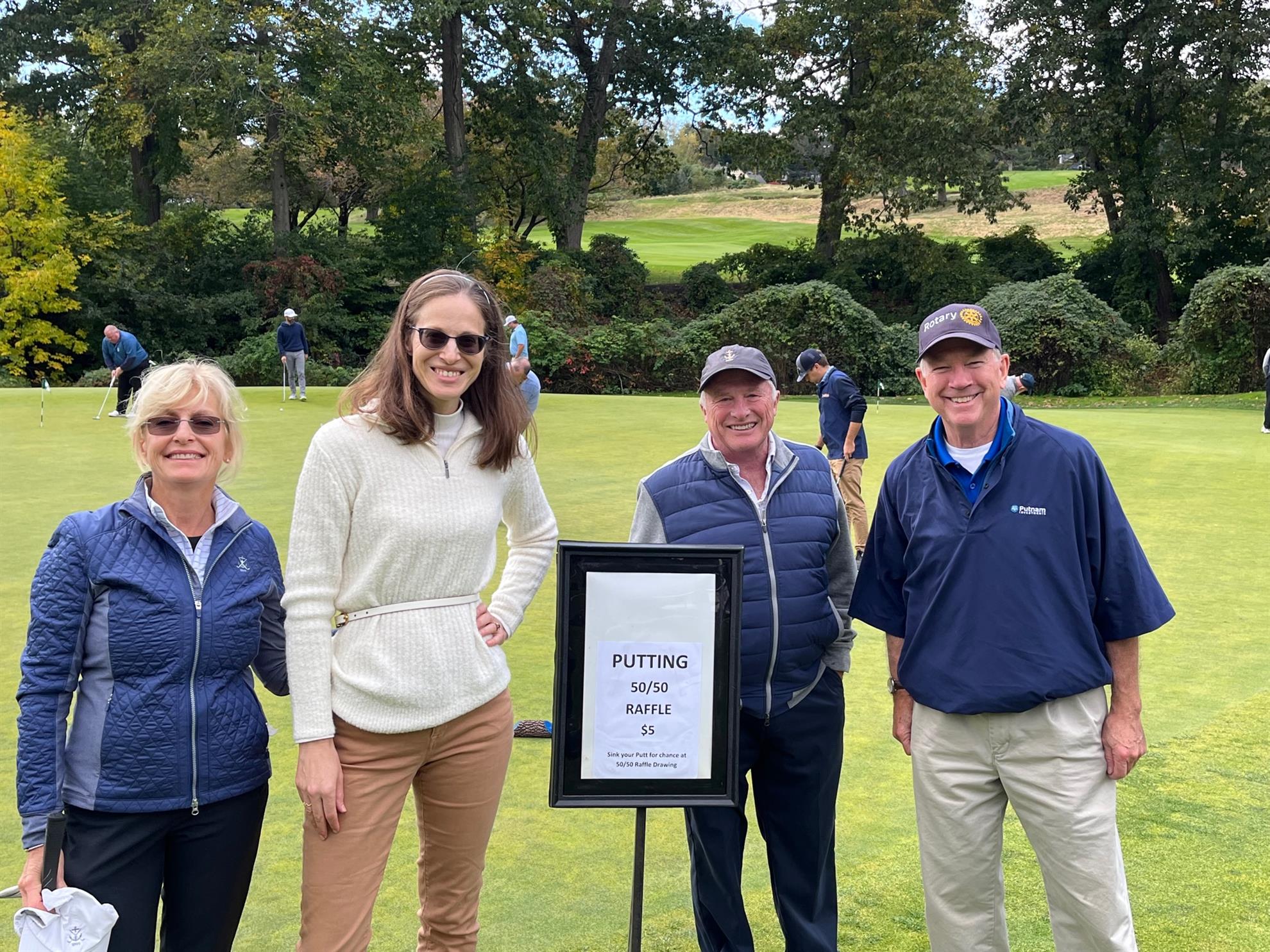
The Eighties saw the club take on additional charitable endeavors and follow new directions in fundraising.For thirty years the major fund raising activity of the club had been the annual auction.The Rotary Barn had become an institution but the eighties had arrived and forces acted to cause the demise of the barn and auction.The procuring of quality merchandise was adversely affected by private yard sales, thus, auction sales declined.The final auction was held in 1985.In 1986 the institution known as “The Barn” came to an end.The barn was sold through an auction process with bidder’s presenting their offer’s in a sealed bid format. In the offering it was stated that the property would be sold as is and the bid could not contain any specific terms, conditions, contingencies or stipulations. The highest conforming bid was for $104,000.00 which the membership voted to accept. The proceeds are being held in trust to continue the club’s charitable efforts. Wasting no time, the club membership set out to develop new and innovative ways to raise additional funds. There was a Cadillac Raffle, the Town Day Dunk Tank, Town Day Barbecue, Town Day Sausage stand and numerous other efforts. One such endeavor, the Pancake Breakfast, which started on Town Day 1988, has gone on to become a Rotary tradition. Hundreds of people come out to support Rotary while enjoying a hearty breakfast of pancakes, sausages and all the fixings. An added perk is seeing the Rotarians don aprons to cook, serve and even bus tables.The Golf Tournament "teed" off in May 1989 and has become the major fundraiser. Through the generosity of The Winchester Country Club, Rotary is able to offer this world class course as a venue for their annual event. This is a major undertaking and requires an effort by the membership to secure sponsors and golfers. Its success has allowed the club to continue with their charitable giving. A new fund raiser was instituted in 2008 that the members hope will become not only an annual event but a major source of revenue. The “Oktoberfest” was held at the Town Hall with an Oompah band, German food and of course plenty of “liquid gold” the mainstay of any Oktoberfest celebration. A moderately successful first effort has given the club the enthusiasm to continue. Maybe someday when autumn rolls around the townspeople will think of Rotary and the Oktoberfest just like when spring was ushered in by the auction.
In 1987 women were admitted to the club. Always a leader, the club was among the first to admit women even before Rotary International changed the bylaws in 1989. The first women members were Elizabeth DiLoreto, an attorney and Betty Kehoe, Mortgage Lending/Winchester Cooperative Bank, both were inducted on the same day in 1987. In 1997 Shirley Potts became the first woman president of the Winchester Club. The addition of women to the membership helped to revitalize and strengthen the club. On Saturday, May 2, 1987 at the Crestview Plaza in Woburn, the club celebrated the Diamond Anniversary of the Rotary Club of Winchester. As the diamond signifies endurance so the club has endured through the continuing efforts of the membership.
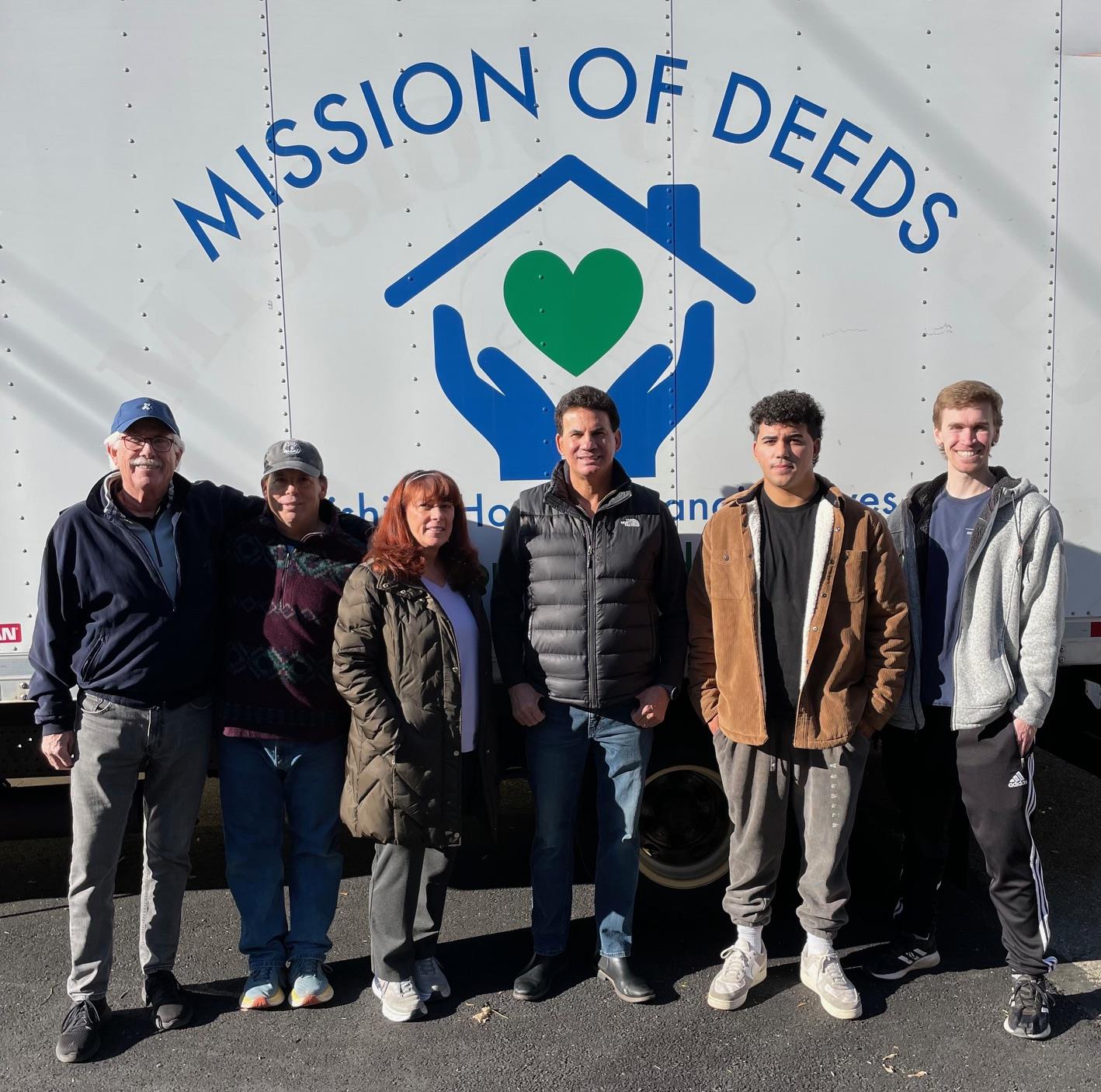
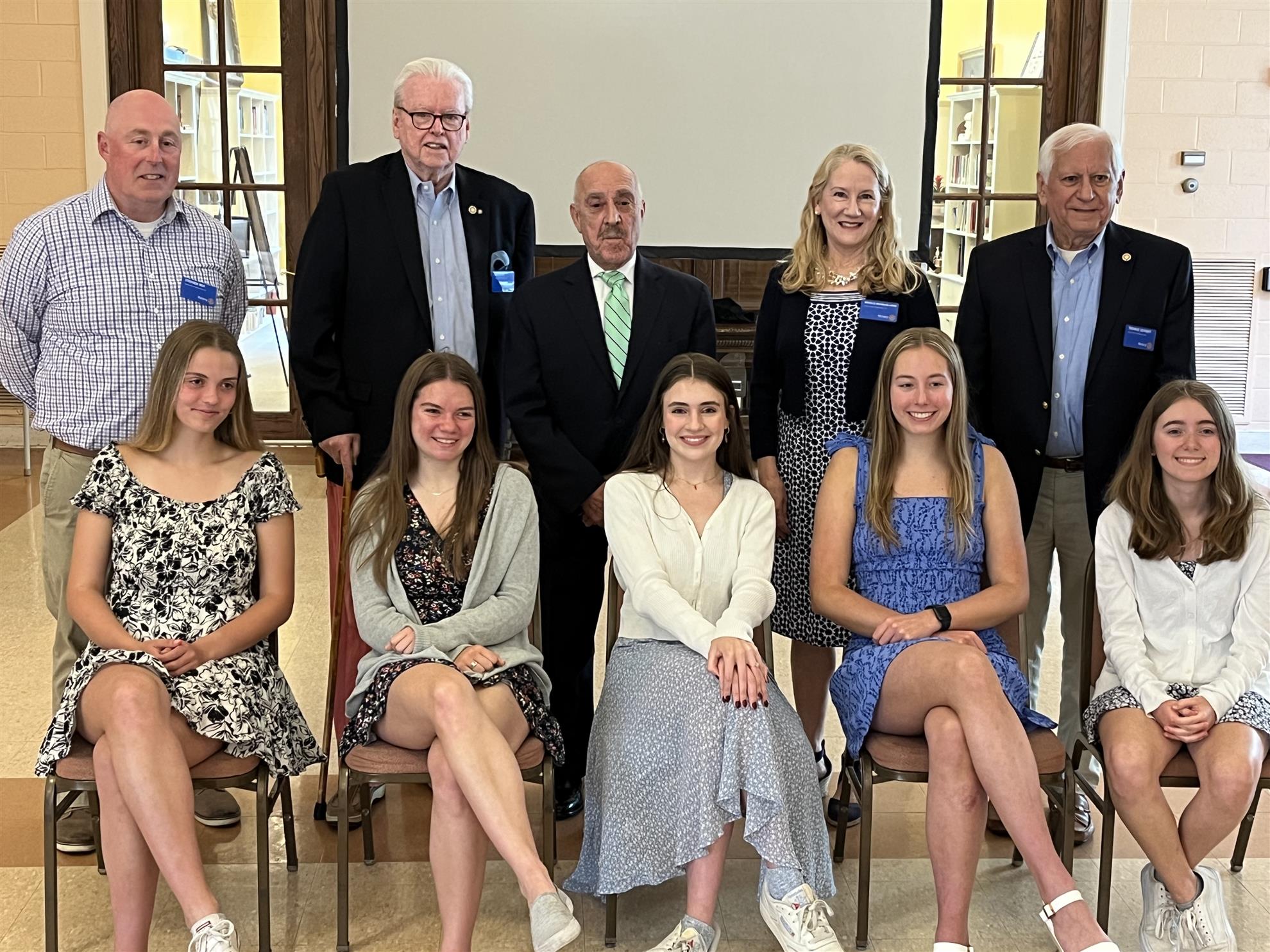
During the 90's and into the new millennium the club has continued to meet the charitable needs of the community. In the spring of 1996, Chandler Parkhurst, a former honorary member, bequeathed $50,000.00 that established the Winchester Rotary Scholarship Foundation. The Harry E. Chefalo fund was later formed and enabled the committee to increase its giving capabilities. At present $4,000.00 to $5,000.00 in scholarships are awarded yearlyto recognize students for community service. The award amounts will grow in proportion to the fund size. There are numerous recipients of charitable giving. The Mission of Deeds, an organization that provides assistance to those in need, has a close attachment to the Winchester Club. Tony Triglione, a member of the Winchester Club, founded the charity to provide furniture and household items to needy families. The Winchester Rotary has provided help in the form of cash donations and members have volunteered their time to help with pickups of donated goods.
Others receiving funding have been; "Big Steps for Little People", Winchester Seniors Association, ABC House, Bridge over Troubled Waters, The Woburn Council for Social Concern, Winchester Meals on Wheels, a new Scoreboard at Manchester Field, Winchester Community Music School, FORCE to fund the Skateboard Park, The North Suburban YMCA, Mission of Deeds,benches for Elliott Park, The Winchester Historical Society, Winchester Fire and Police Departments, The Family Inn, Habitat for Humanity, The Boy Scouts, The Girl Scouts, Camp Rotary, Arlington Boys and Girls Club, The Recreation Department, WHS Marching Band, Good Start at Winchester Hospital, Hospice Care, Bellino Park and countless others. Charitable giving is only one aspect of Rotary’s generosity. This was never more evident than in 1998 when after a “100 year” flood many merchants in downtown Winchester had basements flooded to epic proportions and were left with the task of a major cleanup. Winchester Rotarians only did what Rotarians do, rolled up their sleeves, pitched in, and got the job done.
The Club embarked on a mission during this period which was a case of déjà vu. A simple desire to fulfill the holiday “Wish List” for girls at the Germaine Lawrence School has developed into a long term commitment for the club. The GLS, located in Arlington, is a provider of residential treatment services for troubled adolescent girls. This effort has in many ways mirrored the earlier club efforts involving Winning Farm in Woburn. Winning Farm was long forgotten by the new millennium but the Rotary ideals that spawned that endeavor lived on. The Rotarians saw the needs of the young women from GLS just as the former membership had seen the needs of the young women at Winning Farm. Once again the Winchester Rotary Club provided assistance in many forms. It started with a simple request of nightgowns for the girls and the club responded. The next year the club expanded on the “Wish List” for the holidays and the membership generously donated. From that came the adoption of the Harriet Tubman dorm, now known as the Hirshberg Treatment Center. As soon as the “adoption” was in placethe Rotarians saw that landscaping was needed and in cooperation with Mahoney’s Rocky Ledge the club provided funding and purchased the plantings. Club members with assistance from the girls completed the landscaping. There also was a crew who painted some lawn furniture to put the finishing touches on the project. The long term needs of the girls were considered when Rotarians provided a speakers program to assist them in career planning. It is inspiring to see Rotarians and non-Rotarian invitees willingly give of their time to discuss their vocations and share first hand knowledge with young women who so desperately need guidance. The Arts are an integral part of the girl’s formation and the club has sponsored programs that encompass a wide spectrum. The girls have participated in watercolor classes and are looking forward to pastels and charcoal lessons. PlayMakers, a theater workshop, was formed and the girls rehearsed and performed a staged reading of the play Date Night. An invitation was arranged with the Arlington Friends of Drama to participate in a project that included set construction, painting and other production related tasks. A field trip to the Institute for Contemporary Art was sponsored by the club. Under the auspices of the Winchester Community Music School, there was a series of song-writing workshops, culminating in the making of a CD. Photography was explored with the assistance of two professionals. The club provided disposable cameras and the girls were guided through the finer points of picture taking. There have been outings to The Farm, a raspberry patch where they weed and pick berries and hikes in the Fells where they encounter nature first hand. The club has also involved non-Rotarians to provide services such as a tennis clinic. A ballroom dance program provides the young women with dance skills and poise. Under the auspices of Winchester Rotary, girls from GLS toured The Museum of Our National Heritage with members of the Middlesex Committee of the Women’s Bar Association. They also were invited to attend the monthly luncheon meeting at the Yangtze River Restaurant in Lexington. There is a scheduled golf outing and opportunities to attend the theater are being explored. Winchester’s Farmer’s Market provided an opportunity for members to escort the girls’ on a food shopping trip which ended with the group preparing lunch and dining on their creations. Along with the annual “Wish List”, the Gingerbread House construction party has become an annual event.
In 2002, to commemorate the club's 75th Anniversary Year, there was an unprecedented distribution of funds totaling $75,000.00. Grants were awarded both locally and internationally with $50,000.00 being disbursed locally and $25,000.00 given to international projects. The awards were determined by an application system and a vote of the general membership. There were 11 Grants to local entities and 3 International Grants. The Local Grants were disbursed thusly:
1.$10,000 Winchester Meals-On-Wheels
2.$10,000 Winchester Rotary Scholarship Foundation
3.$5,000 Mission of Deeds, Inc.
4.$5,000 Winchester Fire Department
5.$3,000 Hospice Care, Inc.
6.$3,000 Family Inn Foundation
7.$3,000 Winchester Committee for A Better Chance (ABC)
8.$3,000 Muraco Community Playground
9.$3,000 Woburn Council of Social Concern
10.$2,500 North Suburban Family YMCA
11.$2,500 Bridge Over troubled Waters, Inc
The International Grants were disbursed to the following:
1.$10,000 Hope for the Children of Haiti
2.$10,000 AGAND USA, Inc. Children’s Orphanage, Guatemala
3.$5,000 Friends Forever Peace Programs
The club formally celebrated its 75th anniversary, also symbolized by the diamond, at a gathering held at the Winchester Country Club on Sunday Evening, April 28, 2002. It was a time to pay homage to all Winchester Rotarians living or deceased whose unwavering dedication, untiring efforts and unstinting commitment helped to make Winchester and the world a better place. Seventy-Five years of service to the community is a milestone. The remarkable fact is that it continues.
In 2007 the club’s 80th anniversary and long time member Dick Donovan’s surprise 90th birthday party were celebrated with a luncheon meeting at the Woburn Country Club. Once again the membership reflected on the accomplishments of the past eighty years and looked towards future projects that will build on the legacy that they have inherited. At that time long serving and active member Dick Donovan was noted for 41 years of service to the club over a long and distinguished membership.
The Arts have always been cultivated and supported by the club. Starting with the very first fund raiser, “The President’s Own” U.S. Marine Band concert, the club has always fostered the creative assets of the community. Whether it was sponsoring the Winchester Arts Festival, donating to the Winchester Drama Workshop or contributing to a variety of artistic opportunities within the school system, the Winchester Rotary Club recognized the benefits of arts in the community. That cultural enrichment was most recently provided to the community by sponsoring the faculty recital series at the Winchester Community Music School and gallery exhibitions at the Griffin Museum.
One aspect of the club that always goes unnoticed is the business side of running the day to day operations. The club has always had dedicated members who shared their expertise and served in roles vital to the organization. President’s, Vice President’s, President’s Elect, Club Secretaries, Treasurer’s, Sergeant-at-Arms and Board members through the years have all given of their talents and their most precious commodity, time, to make sure that the club runs smoothly and operates effectively. With the amount of monies that pass through the club, it has taken Treasurer’s, who usually serve for long periods of time, to maintain the books in a thoughtful and professional manner. In other monetary matters the Investment Committee has taken care to ensure that the club’s assets are invested wisely. The skill and knowledge that is provided by these volunteers is invaluable.Likewise the Secretary, who must maintain the minutes and handle all correspondence, usually serves for more than a single term. The Sergeant at Arms is the keeper of order, attendance and the luncheon count. This is a position that is diligently carried out with little or no fanfare. The Roster Book, a mainstay for many years, was a cumbersome binder with all of the member’s personal data which is now available online. In this era of cyberspace the club has kept up with the times. In 2003-2004 the club received an award from the District for the Web Page. The Club Bulletin, where members went for information about the club, was once delivered by “snail mail”. It became an institution under Bulletin Editor Arthur “Red” Rand who, for 15 years, dispensed his brand of humor and rarely if ever missed a weekly edition. Red’s weekly production included a lot of cut and paste when that terminology actually meant cut and paste. Don’t think for a minute though that providing the bulletin today on line is any simple task. It is ataskthat takes that intangible “Rotary Spirit” to make it happen.
There are three individuals who deserve mention for their years of service to Rotary. Each of these members has served Rotary for over 50 years. Nicholas Fitzgerald had a membership that spanned 61 years from 1931 to 1992. Harry Chefalo had a membership that spanned 54 years from 1946 to 2000. Irv Rawding has been a member of Rotary since 1959 when he joined the Boston Rotary. In 1980 he transferred his membership to the Winchester Club and is currently continuing his uninterrupted service.
There are new horizons, new vistas and new challenges for the membership. Their dedication has not wavered and they are ready and eager to continue the efforts started by 24 individuals in 1927 to make a difference in the world. The Rotary motto of "Service Above Self" lives in the Winchester Rotary Club.
Respectfully submitted by:Jack Kean
August 2009
The Club's historian, Jack Kean, presented to the membership at their luncheon meeting on Thursday, March 11, 2010 Bio's of the Club's Charter Members:
Biographical Sketches
of the
Charter Members of the Rotary Club of Winchester
Special thanks to the Information Services Department of the
Winchester Public Library.
Anderson, Victor (Vic) - Victor, born in 1869, was a native of Sweden and emigrated to Malden. He came to Winchester in 1925 and opened Anderson Motors which was located at 666 Main Street. The dealership sold Packard automobiles. In 1931 acquired the Junior Country Club site on Winn Street in Woburn and established a dealership that represented Oakland cars (division of GM), Pontiac, Oldsmobile and Pierce Arrow. He lived at 404 Highland Avenue with his wife Augusta and had one son Oliver. Victor died in a tragic accident in October 1931. He and a friend Herman Shaw were driving in Malden and probably blinded by an oncoming automobile drove through a fence and plunged into the Malden River. Mr. Shaw was able to extricate himself from the vehicle but it was an hour before rescuers could get to Victor who was pronounced dead at the scene.
Classification – Automobile Retailing
Bancroft, George Raymond (Raymond) – George was a dry goods dealer in Winchester for many years. He was born in 1883 in Danversport but was raised in Stoneham. As a young man he worked for Miss F.J. Bowser who operated dry goods stores in Stoneham and Winchester. After getting married in 1911 George moved to Winchester and joined in a partnership with Miss Bowser until he later acquired the business. He operated the business at 7 Mt. Vernon St., later moved to 15 Mt. Vernon St.
and finally moved to Park St. where it remained until he retired. George was very active in the Crawford Memorial Methodist Church and was a trustee emeritus. He lived on Myrtle Terrace when he first moved to Winchester and then had a house built on Highland Ave. George was married to his wife Grace for 50 years and they had a daughter, Marion and a son, Dr. G. Raymond Bancroft Jr.. George passed away in 1963.
Classification – Dry Goods Retailing
Beggs, Daniel R. (Dan) – Dan was president of Beggs & Cobb Inc. a leather tannery located on Swanton St. at the present site of the Parkview Condominiums. In September of 1959 the tannery was destroyed in a spectacular fire, the largest fire in Winchester history. He was born on November 19, 1875 in Woburn, where he lived for 40 years, attended the Woburn schools and graduated from the Bryant & Stratton Commercial College. After college he entered the family business which was started by his father, advanced through the various departments and succeeded his father upon his death in 1915. In 1915 he moved to Winchester into the house he built at number 2 Everett Avenue. Dan was a 32nd Degree Mason and was a member of the Mt. Horeb Lodge of Woburn which he joined in 1907. He was also a Shriner with the Aleppo Temple of the Mystic Shrines. He held memberships in the Woburn Lodge of Elks, The Winchester and Salem Country Clubs, The Winchester Music Garden and the Calumet Club. Dan was a member of the Woburn City Council in 1902 and from 1909 to 1926 he was a director of the Woburn National Bank. He was an accomplished violinist playing in orchestras around the area. Daniel was married twice. In 1896 he married Maude E. Merrill of Woburn. She died in 1936. In 1940 he married Rubie Gaskill. He had a son Daniel and a daughter Isabel. Dan died in January 1955.
Classification – Sole Leather Tanning
Bonnell, Ralph H. (Ralph) – Ralph was the founder of Bonnell Motors Co., Inc. The company was started in 1925 and was located at 742 Main Street, Winchester. The business is now located at 353 Cambridge St., Winchester. Ralph was married to Mildred and they had five children, Barbara, Shirley, Ralph Jr., Bruce and Beverly. The family resided at 88 Arlington, Street. He was a member of the Unitarian Church. Active in town politics he served three terms as a selectman and acted as chairman. Ralph was also on the Planning Board and gave ten years of service to the Republican National Committee and was a member of its executive committee. Ralph was one of the founding members of the Francis Ouimet Caddy Scholarship Fund. In addition he was secretary for the Mass. Auto Dealers Association, a former member of the Union Club of Boston, St. Bernard’s Commandery and an honorary director of the Winchester National Bank. (Sovereign Bank) Ralph died in 1975.
Classification – Automobile Parts and Accessories Retailing
President - 1938-1939
Davidson, George Thomas (George) – The first president of the Rotary Club of Winchester was a plumber and one of Winchester’s most widely known citizens. He followed in the footsteps of his father who was an established plumber in town. The early family home was on Thompson St. and they then moved to Washington St. to the property next to the First Baptist Church. In 1910 he moved to 19 Park St. where he resided until his death. George was active in the First Congregational Church where he served as head deacon for many years. A passionate baseball fan he was president of the Winchester Baseball Association which fielded one of the best semi-pro teams in Greater Boston in 1913-14-15. George was a member of William Parkman Lodge of Mason’s, Knights Templar, Aleppo Temple of the Mystic Shrine, and past chief of Clan McKinnon, Order of Scottish Clans. He was a charter member of the Winchester Lodge of Elks. George was chairman of the Winchester Community Relief Committee, a group organized to assist the less fortunate in Winchester at Thanksgiving and Christmas. George was married twice, first to Allie Elizabeth Patterson who died in 1949 and then to Eleanor Mary Livingston. He had 3 daughters, Mrs. Ruth Hilton, Mrs. Colver Dyer, Mrs. Paul Eaton and 2 sons, Homer G. and George T. Very active in town life he served on numerous boards and commissions for 34 years. His service included the Warrant Committee, now the finance committee, as selectman from 1913-1916 and as a member of the Board of Park Commissioners from 1917 to his retirement in 1946. He was elected chairman of the Park Board in 1918 and served in that capacity until 1946. George is credited with the beautification of Winchester overseeing the construction of playgrounds, swimming beaches with bathhouses, and tennis courts. He oversaw the conversion and beautification of 12 parks and 19 town-owned plots that were changed from ugly eyesores into attractive pieces of property. The Town, in 1954, dedicated a park development on Cross St. near the old Winn watch-hand factory to honor his service to the park Department and the town. George passed away in April of 1954.
Classification – Plumbing
President – 1927-1928
Gleason, Loring P. (Buster) – Buster was born in Everett in March 1896. Loring owned and operated the Edward T. Harrington Co. a real estate company located at 39 Church St. for many years. In later years he became associated with the Somerville National Bank which later became the Shawmut Bank. A graduate of Phillips-Exeter Academy class of 1917 he enlisted in the U.S. Navy after graduation and served during World
War I. Buster lived on Rangeley Road for many years with his wife Helen. He had two daughters Joan and Suzanne. Loring passed away in October 1983.
Classification – Real Estate Agency
President – 1930-1931
Hindes, Dr. J. Churchill (Doc or Church) – Doc Hindes started his practice in Winchester in 1905. He was born in Vergennes, Vermont in 1875, graduated from Vermont Academy in 1895 where he played football in the days of the old “guards back” and “flying wedges” plays, and from Harvard Dental School in 1898. He practiced in Vergennes for several years before coming to Winchester in 1905. His resided on Sheffield Road, moved to Crescent Road and lived out his final years at Stetson Hall on Elmwood Avenue. His love for football found him in regular attendance at the Winchester High School football games. His popularity around town and his passion for football led a group of friends to establish the “Doc” Hindes trophy which went to the most valuable player on the team. Doc had a beautifully trained bass voice and sang in a quartet at the First Congregational Church. He played leading roles in musicals staged at the Calumet Club. He was the song leader at weekly luncheons for The Rotary Club for many years. “Church” was a charter member of the Mystic Glee Club and also of the William Parkman Lodge of Masons. The Hevey Block, corner of Mount Vernon and Main, housed his first office and when the Star building opened in 1914 he moved there to the second floor. T. Price Wilson, a Rotarian and owner of the Star building had a handshake agreement on the lease until Doc retired in 1951 due a problem with his sight. The Girl Scout Cabin in the Fells was special to him and he was active in its construction and spent much time there after its completion. Doc Hindes married his wife Patience in 1907. They had a son Gordon. Doc Hindes died at age 89 in April of 1965.
Classification - Dentistry
President – 1931-1932
Kelley, Daniel (Dan) – Daniel Kelley was founder and president of the old firm of Kelley & Hawes, undertakers and furniture movers. He was born in North Woburn in 1862. His early education was from the school of experience and hard knocks, coming to Winchester as a penniless boy of 16 in 1878. His first job was with the A. Winn & Son livery and transportation business. Winn and Son provided the only public conveyance available in town and Dan worked 24 hours a day, living at the stable and being on call 24 hours a day. Five doctors boarded their horses at the stable and Dan would drive the doctors most times to deliver babies. In 1890 Dan acquired A. Winn’s interest in the firm and in 1893 took over complete ownership. He studied embalming in 1890 and added that to the firm’s offerings. Dan also printed the first small card size local railroad schedule. In 1900 the firm of Kelley & Hawes was formed when Dan and D.W. Hawes joined forces. They maintained a livery stable, undertaking services, an express service and furniture moving. Through the years the firm motorized and provided fire-proof storage. In 1937 then Eastman Funeral Service of Boston acquired the management of the funeral business but Dan retained an active interest in the business. He was active in the William Parkman Lodge, Aleppo Temple of the Mystic Shrine. Dan was a member of the Waterfield Lodge of Odd Fellows, a member of the Calumet Club, and the Winchester Chamber of Commerce. He was a 50 year member of the First Congregational Church and served eight years as a deacon. His charitable works mostly unknown to the public shows his propensity for sending aid where it was most needed. He took great satisfaction in assisting worthy people of all sorts and conditions. Dan was married twice. His first wife Martha whom he married in 1890 died in 1922. In 1928 he married Isabel and they had a daughter Mrs. F. Milne Blanchard. The family lived at 4 Dix Street. Dan died in August 1940 and the following tribute appeared in the Winchester Star:
“He Wept With Those Who Wept”
Tho humble his birth, humbler he grew
This man with great love in his heart
No sickness, no suffering, no sorrow he knew
But that he did more than his part
And those who are left know a want that is great
For a man whose whole life was a life without hate
“One who admired and respected Mr. Daniel Kelley”
Classification – Funeral Directing
Knight, Frank H. – Frank was a native of Durham, Maine. He graduated from Bowdoin College in 1894 and enrolled in the Mass College of Pharmacy. He completed the course in three years. Frank received his degree in 1898 and continued his necessary apprenticeship at J.G. Gooding & Co. on Dartmouth St. in Boston. In 1897 he passed the exam of the Massachusetts Board of Pharmacy and in 1901 was also registered in Maine. After spending four years at Gooding and four more in Waltham with H.I. Johnson he purchased the Young & Brown Pharmacy at the corner of Church and Main Sts. in 1906. Frank ran the pharmacy until he sold it in February 1935. Frank was a member of the William Parkman Lodge of Masons and was a director of the Winchester Chamber of Commerce. He was a talented musician and was associated with the Winchester Music Garden. Frank resided at 4 Ridgeway.
Classification – Drugs Retailing
McLatchy, Allen Hill (Mac) – Allen, a native of Woburn, was born in 1888 and educated in the Woburn Public School system. Mac was the owner of the A.H. McLatchy Co., Inc. located at 18 Cross Street. The firm specialized in patent-leather which is leatherthat has been given a high gloss, shiny finish. Patent leather has long been established as leather that is considered uptown and formal. More precisely the company tanned upper leather which was the leather used for the vamp (front) and quarter (rear and sides) of a shoe. Mac worked in the leather business for over 30 years until retiring in 1947. Allen was a member of the Masons, Mount Horeb Lodge and was a life member of the Aleppo Temple of Boston. Mac and his wife Catherine had 3 sons, Allen Jr., Robert and Charles and 3 daughters Gladys, Barbara, and Thelma. Allen Hill McLatchy passed away on March 20, 1973. He resided at 28 Eaton Avenue, Woburn, MA.
Classification – Patent Upper Leather Tanning
President – 1933-1934
Nichols, Nathaniel M. (Nat) – He was born in March 1866 on Staten Island, New York, in the home of his maternal grandfather, Nathaniel Marsh, who was the first president of the Erie Railroad. His ancestors were among the founders of Haverhill and his father was one of the first to bring the shoe industry to that city. His youth was spent in Haverhill, early education was in private schools and he also studied abroad. With the untimely death of his father he started a plumbing and heating business which he conducted for several years. Nat moved to Winchester and resided at 29 Crescent Road. He later worked for heating company that installed heating systems in many of the old wooden school buildings in Winchester. Through this association in 1900 he was employed by the School Department to take charge of maintenance, purchasing, and supervision of the janitors. He also was the attendance officer for the school system. Nat was interested in methods of teaching and seating and after studying other school systems he introduced adjustable seats into the Winchester School buildings. Nathaniel also oversaw the maintenance of many church and commercial buildings in Winchester.
In 1925 he left the School Department and was elected collector of taxes. He was regarded so highly that until he was forced to retire in 1936 at age 70 he had been reelected during every election cycle since 1925. Nathaniel worked for tax legislation and reform and was responsible for introducing many bills in the Legislature. Nat served for 20 years as executive secretary for The Massachusetts Collectors and Treasurers Association.
Nathaniel was very interested in charitable works and for many years he sponsored a Christmas party for less fortunate children. The event became so large that the Winchester Lodge of Elks took over the party.
He was a Trustee of the Elks, a member of the First Congregational Church and a life member of the Appalachian Mountain Club, serving as president of the Chatham Trails Association. Nathaniel was instrumental in starting a number of the Appalachian Club camps and especially the Cold River Camp in Chatham, New Hampshire. He put in a trail leading to the camp from the Presidential Range.
Nathaniel owned one of the first automobiles in Winchester, a one-cylinder Knox. He received his registration number 1161 in 1902. Prior to purchasing an automobile Nat would travel from school to school on his motorcycle.
He was married to his wife Mabel in 1892 and they had two daughters, Mrs. Frederick Pierce and Doris Nichols.
He died in December 1947. Dr. Chidley in his eulogy talked of Nat’s integrity, courage, loyalty and kindliness.
The following Resolution was adopted by the Rotary Club, presented at a regular meeting by Dr. Richard Sheehy and published in the Winchester Star on January 2, 1948:
Whereas:
On December 27, 1947, Nathaniel M. Nichols, our fellow member, and a
charter member, of the Winchester Rotary Club, passed to his reward,
And Whereas:
In losing him we have lost a very devoted Rotarian who was faithful in his attendance and a man, to whom fellowship of Rotary meant much,
And Whereas:
Nat Nichols was a good Rotarian, a good citizen, and a good man, exemplifying the old fashioned New England Yankee, a man who spoke his mind, strict in his convictions, with no deceit in him; charitable personally, but never swayed by charity from his duty,
And Whereas:
Such men as Nat Nichols had a great part in building our country, asking no help, being self reliant and self respecting,
And Whereas:
We ask God to grant that the race, of which he was one, shall never fail us,
Therefore, be it resolved:
That the Winchester Rotary Club mourns his loss and expresses to his family
its sincere sympathy.
Also, that:
These resolutions be spread upon the minutes of the meeting, and a copy be
sent to Mrs. Nichols.
Classification – Municipal Government
Priest, William Emerson (Bill) – Bill was a former treasurer of the Winchester Savings Bank. He joined the bank in 1917 when was elected treasurer. Prior to his arrival in Winchester he was with the North End Savings Bank. In 1922 he was elected a corporator and trustee of the Winchester Savings Bank. He retired as treasurer in 1956 but continued as coroporator until 1974 after being associated with the bank for 57 years. Bill was elected town auditor in March 1922 and served in that capacity for two years at which time a change in the statute provided for the appointment on a town accountant. He was appointed to this post in 1924 and served until 1951. Bill was also an ex-officio member of the Retirement Board from 1939 until 1951. In 1953 he elected commissioner of Winchester Trust Funds and held that office until 1936. Bill lived at 9 Sanborn St. with his wife Ruth. They had one son Emerson C. Priest. Bill passed away in May of 1974.
Classification – Savings Banking
Puffer, Stanley B. (Stan) – Stan was the owner and proprietor of the Puffer Manufacturing Company on Swanton St. The company was one of the premier makers of soda fountains in the United States. He was born and educated in Medford. Active in Winchester, he was a member of the William Parkman Lodge AF & AM and the Winchester Lodge of Elks. He resided at 6 Harrison St. with his wife Amelia, his son Stanley and a daughter Ester. Stan died in July 1967.
Classification – Soda Fountain Manufacturing
Quinn, James J. (Jim) – Jim Quinn was born in 1888 in Whitinsville, Massachusetts. He attended Worcester Academy and graduated in 1912 from Amherst College. Jim received his Masters from Harvard in 1914 and had further studies at Columbia, Harvard a second time and in 1920 he studied accounting at Boston University College of Business. His first teaching assignment was at Cushing Academy in Ashburnham and he went on to serve as principal in a High School in Warner, New Hampshire and then at a grammar school in Spencer, Massachusetts. His first tenure as a superintendent was in the School District comprised of Randolph, Holbrook, and Avon. He stayed in that position for 3 years. In 1921 he was named Superintendent of the Turner Falls School system and remained there until being named Superintendent of Winchester Public Schools. Jim started his tenure as Superintendent of Schools in Winchester November, 1923 and held the position until his retirement in 1945.
Jim holds the distinction of being a Charter Member of 2 Rotary Clubs. While in Turners Falls, despite having lived there for only 1 year, Jim was asked to be the first President of the Turners Falls Rotary Club.
In 1935 the Town was struggling with the proposal for a motion picture theater in Winchester. Jim, in ardent opposition, stated his beliefs in a letter to the editor published on the front page of the Winchester Star. He wrote “Sex, crime, or violence of some sort have been, and still are, pictured way out of proportion to normal living. With such pictures in preponderance and children, on the average, throughout the United States, attending moving pictures once a week, there can be no doubt in my mind what the resultant effect would be upon our children’s imagination, health, emotions, attitudes, thoughts and conduct” (On December 21st, 1937 the Loew’s Theater opened in Winchester) Jim resided at 307 Washington Street with his wife and son.
Classification – Educating – Public Schools
Randall, Denton W. (Denton) – Denton was the proprietor of Randall’s an ice cream, candy, catering and restaurant establishment on Mount Vernon St. (Lucia’s operates at the site now) He was born in 1892 in Prince Edward Island, Canada. His boyhood was spent on Peak’s Island in Casco Bay, Maine. He later lived in Boston and Somerville. Schooling took place at Portland H.S., Roxbury H.S. and he graduated from Somerville High School. After high school he attended Massachusetts Agricultural College the forerunner of the University of Massachusetts. In 1914 he came to Winchester and joined his father at Randall’s. People came from far and wide for Randall’s homemade ice cream. When his father died in 1921 Denton took over the business and ran it until he retired in 1948. Denton resided on Lloyd St. and later for many years at 27 Everell Road. The family spent their summers on Peak’s Island for 40 years. During World War I he served in Naval Aviation and was a member of the American Legion. He was a member of the William Parkman Lodge, The First Congregational Church and he was a Town Meeting member for Precinct 3. His wife was Lucy and they had 2 daughters, Mrs. Philip Cabot and Mrs. Thomas Hoover.
Classification – Confections – Retail
Randall, Frank E. (Frank) – Frank was the manager of The Edison Electric Illuminating Company of Boston located at 4 Mount Vernon St.. The office provided a place for customer to pay their bills and also served as a showroom for appliances. The Edison Electric Illuminating Co. was established by Thomas Edison in 1880. The Edison Electric Illuminating Company of Boston was established in 1886 and in the mid 1900’s changed its name to Boston Edison until the formation of NSTAR in the 1990’s.
In 1927 Frank resided at 29 Nelson Street.
Classification – Electric Light and Power Service
Reed, Rev. George Hale (George) – George was born and raised in Taunton, MA. His father was editor of the daily paper in Taunton and this led George to love to write. He derived the most happiness from writing. Up until his senior year at Harvard he had prepared for a career in the Law. George entered Harvard Divinity School from where he graduated with the class of 1902. In the same year he was ordained at King’s Chapel, Boston. Before coming to Winchester he served in Fairhaven and Belmont.He came to Winchester in 1920 as the pastor at the Unitarian Church on Main Street. George was an avid reader and particularly biographies of which he said “the biography is the case book for the ministry”. He was most inspired by the biographies of Abraham Lincoln. His favorite writer was Gamaliel Bradford who was regarded as the “Dean of American Biographers”. George believed the thought expressed by one of his professor’s that “The minister should take the people where they are and leave them where they ought to be”. Rev. Hale considered the radio to be great blessing. “The memorial service for Thomas Edison was one of the most impressive “radio hours” to which I have ever listened.” His prescription for permanent peace among the peoples of the world is by applying the “golden rule”. Whenever possible he made the rounds of his parish on foot. He relished walking. The movies or the theater provided relaxation as well as a good game of bridge. George was a man of tolerance, faith and encouragement. He preached mutual understanding, sympathy and friendliness. In 1933 he was most impressed with how the town came together, every organization, every creed and every color represented to combat the unemployment situation. He was married to his wife Eleanor in 1917 and they had two daughters Judith and Suzanne.The family resided at 6 Ridgefield Road.
Classification – Minister, Protestant Churches
Richardson, Harris S. (Hack) – Harris was born in Vershire, VT in 1887. He attended Chelsea High School and Harvard University. For many years Harris owned and operated Richardson’s Market on Mount Vernon Street. Harris was active in town politics having served as chairman of both the Finance Committee and the Board of Selectmen. He also served on the Board of Appeals and the Planning Board. In 1936 he was elected to the Massachusetts State Senate where he served on a number of legislative committees and served as chair of the Ways and Means Committee from 1943-1947. In 1948 and again in 1950 he was Senate president.
Richardson was first vice president of the Winchester Trust Company, a past master of the William Parkman Lodge of Masons and served on the Prudential Committee of The First Congregational Church. He was married to Ann Thayer. They had son Harris S. Jr. and the family lived at 15 Mount Pleasant Street. Harris passed away in February 1976.
Classification – Groceries Retailing
President 1928-1929
Sanderson, Edmund C. (E.C.) – E.C. was born in Winchester in April of 1878. He was educated in the Winchester schools and Burdett Business College. Upon graduation he went to work for Mr. Charles Thompson, chief engineer of the original Cape Cod Canal Company, who lived in Winchester and was acting as Town Engineer for Winchester. While working with Mr. Thompson he helped make many of the early street surveys and layouts for Winchester. On the death of his father, Charles F. Sanderson, he took over the hardware business which was established by his grandfather, Edmund Sanderson. In 1906 he started an electrical construction business in Winchester which he ran until his retirement in 1933. The business was located at 9 Thompson Street. He was elected to the Water & Sewer Board in 1916. He served on this Board for 35 years. Edmund was a member of the Water Works Association and the Massachusetts Charitable Mechanic Association of Boston. E.C. was a member of the William Parkman Lodge of Masons and Knights Templar. He was a member of the First Congregational Church, a director of the Winchester National Bank and during World War II he served as local Civilian Defense Property Officer, being in charge of the Emergency Public Works Division of the Civil Defense Committee. In 1899 he married Lilla Whitford of Winchester and they had a son Edmund Whitford Sanderson. Lilla passed away in 1942 and E.C. was remarried to Arletta Martin. The family resided at 2 Dix Street. Edmund passed away in 1951.
Classification – Electric Construction
Sheehy, Dr. Richard W. (Doc) – Doc Sheehy was born in Weymouth in 1883. He attended schools in Weymouth and went to Tufts University where he received his medical education. During World War I he served as a Captain in the U.S. Army Medical Corps. He practiced medicine in Winchester for 60 years and was Chief of Staff at Winchester Hospital for 21 years. Doc Sheehy was a general physician who called on patients’ day or night in the horse and buggy days. He was a founder and past vice president of the Winchester National Bank. Doc was a charter member of Post 97 American Legion, The Knights of Columbus, and the St. Vincent dePaul Society. He belonged to the Catholic Alumni Society of Boston, was a charitable past president of the Charitable Irish Society of Boston and of the St. Luke’s Guild in Boston and a member of the Clover Club. The Rotary Club made him an Honorary Life Member. Doc Sheehy and his wife Emily resided at 21 Washington Street. They had one son Richard W. Jr.
Dr. Richard Sheehy passed away on October 20, 1966.
Classification – Physician
President – 1958-1959
Symmes, Irving Livingston (Irving) – Irving was a member of one the town’s oldest families. He was a direct descendant of Rev. Zaccariah Symmes who received a grant of lands in Winchester from the British Crown when the town was known as Charlestown Village and was an uninhabited wilderness. He was born in Winchester in 1866, was educated in the public schools and was a life-long resident. For more than 50 years, until his retirement in 1939, Irving was in the produce business known as I.L. Symmes in Winchester, located in the C.H. Symmes Co. building at 747 Main Street. The family owned a farm that sat between Main Street and Highland Avenue, near Symmes Corner. The farm included “two barns, three squash houses, a wash house, a wagon house, two sheds, and five green houses. An ice house was located near one of two small ponds, and there was also a poultry house.” Irving was connected with the Fire Department in the early days before the introduction of horse-drawn equipment. In 1895 he was the call chief of the department. He served in 1895-1896 and from 1901-1910. When he left the department in 1910 he was drawing a salary in the princely sum of $250.00 a year. Symmes got his experience as a fireman running with Black Horse Hose No. 2, one of several hand –drawn carriages located around town. During the Tercentenary in 1930 Irving served as Marshall of the featured Fire Division in the Tercentenary Parade. He served as Forest Fire Warden and was also Inspector of Wires from 1900 to 1902. In 1930 he was elected Selectman, served for three years and acted as chairman in 1933. Irving was a member of the William Parkman Lodge, The Winchester Elks, The Calumet Club and was a member of the Unitarian Church. He was married twice. His first marriage in 1896 was to Annie Dean who died in 1935. The second marriage, in 1941 was to Mildred Wickson. There was one son Dean. The family resided at 10 Madison Avenue. Irving died in 1948.
Classification – Feed & Grain Retailing
Wallace, Roscoe C. (Roscoe) – He was born in Malden in January 1889. During World War II he served in the U.S. Army Air Forces as a Major, from January 1943 until May 1945. In 1927 Roscoe was the Sales Manager for the New England Laundries. The New England Laundries, Inc., located in the building now known as The Mill Pond Building on Converse Place, had plants in Boston, Somerville, Winchester, Watertown, Lowell, and Springfield. In a Globe article from November 6, 1926 it was stated that The Winchester Laundry, before joining the N.E. Laundries group was known as a splendid modern facility and included the plants in Lowell and Watertown. The formation of N.E. Laundries was a consolidation of several plants meant to take advantage of the latest technology that had revolutionized the laundry industry. He was a member of the First Baptist Church and The Wyoming Lodge of Masons both in Melrose. Roscoe and his wife Ethel had 2 sons, Roscoe Clark Jr. and Leonard G. and in 1927 they lived at 59 Crystal St. in Wakefield.At the time of his death in September 1971 he lived in Melrose.
Classification - Laundries
President – 1929-1930
Walsh, Patrick T. (Pat) – Pat was born in Kilmichael Parish, County Cork, Ireland in 1860. He emigrated to America and settled in Somerville before coming to Winchester in
1880. His trade was a leather worker and he worked at the old Maxwell plant in Winchester which later became J.O. Whitten Co. on Cross Street. He was a “splitter” at the Loring & Avery plant later known as Beggs & Cobb. Pat also worked for a time in Salem, all the while investing his money in Somerville real estate which he later sold and made a tidy profit. In 1896 he joined the firm of Eastern Felt, formerly known as Cowdrey, Cobb, & Nichols, located on Canal Street, and he rose to the presidency. He was a member of the Knights of Columbus, Council 210, The Winchester Lodge of Elks, The Charitable Irish Association and the Holy Name Society of St. Mary’s Church. His charity was well documented but little known by the public. He was married twice. His first wife passed away. The second Mrs. Walsh was Mary Frances and she died in March of 1941. Pat first lived in house he built on Main Street near Hemingway. Later he lived on Highland Ave. and then for 23 years he lived on Oxford St. He died in 1942 with no immediate family.
Classification – Felt Manufacturing
Wilson, T. Price (T.P.) – T.Price was born in Cambridgeport in December of 1879 but spent almost his entire life in Winchester, moving here when he was 9 months old. He grew up on Wilson Street in the house his parents built. Wilson attended the Highland School, then a one room building. He later attended the original Wadleigh School and the former high school known as the Prince School located at the corner of Church and School Street. T.P. graduated from Winchester High School in 1898 and went right to work for his father and mother at the Winchester Star. His mother was one of the first newspaper women in Boston and was the proof-reader and a regular contributor to the Star. He learned the publishing business from the ground up. Price opened the office daily at 6:00A.M., swept the floors, tended the fires, set type, reported, and wrote ads until closing at 6:00P.M. The Star was first published on the top floor of the Miller Block, which was located between the Fire Station and the Aberjona River on Mount Vernon Street. It was next located in an old eight sided school building on a small hill on the corner of Converse Place. The Star next moved to the Lyceum Building, corner of Mount Vernon and Main streets on the first floor with the press room being on the second floor and the Star press in the basement. In 1915 T.P. and his father oversaw the erection of the building on Church Street. When T.P.’s father opened the stationery store on the first floor of the new building he took an active interest in that end of the business and managed it for many years. When his father died in 1919 Price took over the business and became owner, editor and publisher of the Winchester Star. One of his last editorial campaigns was in opposition to the abolition of the grade crossing and by raising the tracks. He never ran for public office though urged to do so often because he felt that it would hinder the Star’s independence. T.P. did accept two appointed positions, one as Registrar of Voters, the other as a member of the Board of Cemetery Commissioners. He was a charter member of the Winchester Boat Club, served as Commodore of the Medford Boat Club and was a member of the American Canoe Association. T.P. was a member of the Calumet Club and had a reputation as an above average bowler and billiards player. T.P. was a member of the William Parkman Lodge of Masons, charter member of the Winchester Lodge of Elks, Winchester Historical Society, and countless other organizations in and around Winchester. His Stutz “Bearcat” and later his Stearns motor cars were known far and wide. He was a familiar figure around town noted for his white cap and briar-root pipe. For many years he lived on Wolcott Terrace. He built the house on Rangely Rd. prior to his marriage to Frances in September 1931. They had two daughters Mrs. Joseph Day and Mrs. Richard Hakanson.
T.P. died in June of 1954 and the town flags were displayed at half-staff.